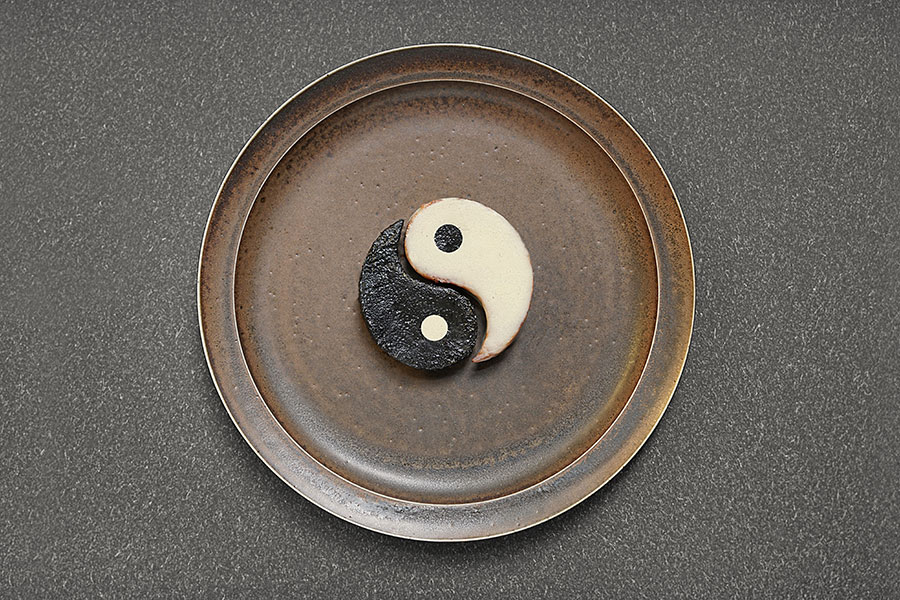
Yin and Yang
Introduction
Yin and Yang is a fundamental concept in Chinese philosophy and culture, representing the dual nature of reality. It describes how seemingly opposite forces may actually be complementary, interconnected, and interdependent in the natural world. This duality is observed in various elements of life, including the sun and moon, light and darkness, life and death, and activity and inactivity. The philosophy of Yin and Yang is central to various aspects of Chinese culture and has influenced traditional Chinese medicine, martial arts, and architectural practices among others.
Philosophy and Symbolism
The Yin-Yang philosophy is rooted in Taoism, an ancient Chinese belief system that emphasizes living in harmony with the Tao, meaning the "way" or "path". Yin and Yang are depicted as a circle divided into black and white segments, representing different energies that are opposite but together form a whole. The black side, Yin, symbolizes the feminine, the moon, darkness, and receptivity. The white side, Yang, represents the masculine, the sun, brightness, and the active. This balance is essential for harmony in the universe.
Historical Development and Applications
The origins of Yin and Yang can be traced back thousands of years to ancient Chinese cosmology and have been integrated into various Chinese cultural practices. In traditional Chinese medicine, for example, health is believed to be a state of balance between these two forces. Acupuncture, herbal medicine, and dietary therapy often seek to restore this balance. The concept is also prominent in Chinese martial arts, such as Taijiquan, which uses the flow of Yin and Yang to enhance physical coordination and mental discipline.
Influence on Taijiquan
Taijiquan, a form of martial arts, embodies the principles of Yin and Yang through its slow, circular movements combined with sudden strikes, reflecting the balance of energy, or Qi. It is both a physical exercise and a method of cultivating inner peace, emphasizing breath regulation and the cultivation of a neutral mind. Taijiquan was inscribed in the UNESCO Intangible Cultural Heritage list in 2020, recognizing its cultural significance and widespread practice among diverse communities worldwide.
Architectural Significance
In traditional Chinese architecture, Yin and Yang are manifested in the design and structure of buildings. The use of space, light, and materials is carefully balanced to create harmony and balance. For example, the interplay of solid and void, light and shadow, and the flow of air and energy in a building reflects these principles. Sunmao, the ancient Chinese art of joinery without nails, uses the Yin and Yang concept to ensure stability and flexibility, which has been crucial in the building of structures capable of withstanding earthquakes.
Modern Cultural Influence
The principles of Yin and Yang continue to influence modern Chinese culture and philosophy. From fashion to culinary arts, and from understanding time through solar terms to new expressions in contemporary art, the balance of Yin and Yang remains a guiding philosophy. The idea of balancing opposites is also gaining appreciation globally, influencing holistic practices and lifestyles that aim to harmonize body, mind, and environment.








